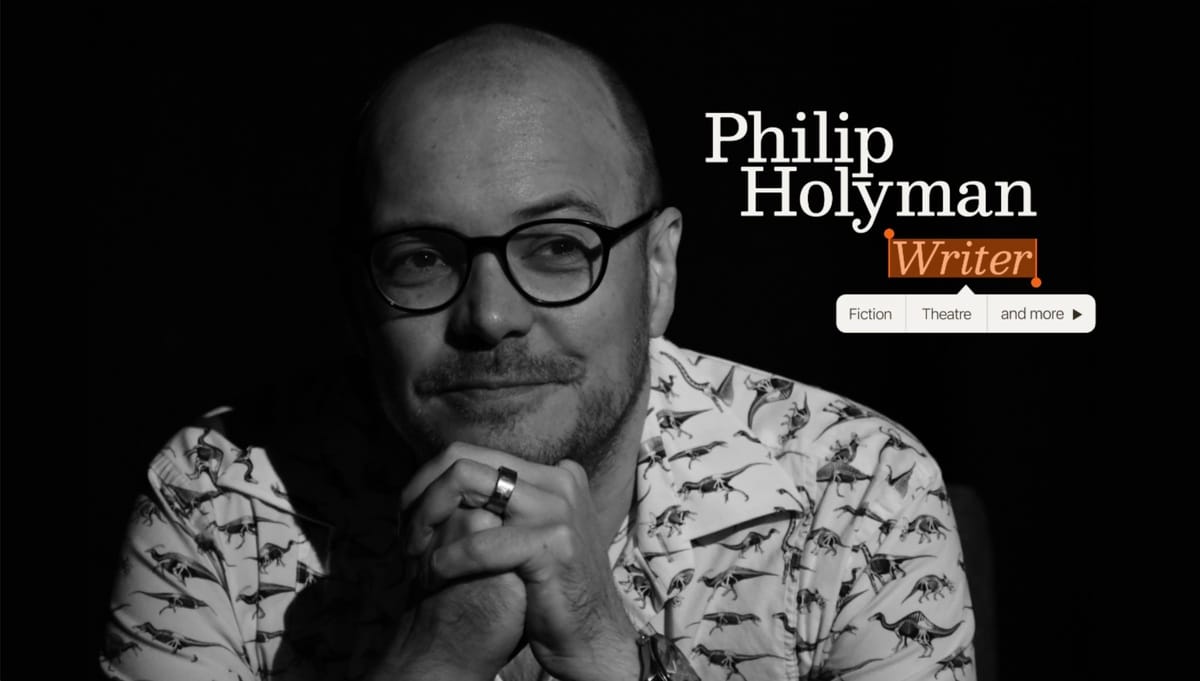
Beehiiv is where I’ll be sharing a selection of posts from “But anyway, I digress…” which is my regular blog over on my personal website — to see all my posts in full, and for more information about my writing, head over to philipholyman.com

23rd December 2025
If Ursula K. Le Guin’s The Dispossessed felt like the novel for our times at the start of 2025, then with 2026 looming on the horizon, that crown has been firmly supplanted (in Britain at least) by J. G. Ballard’s final work, Kingdom Come.
The book celebrates its 20th anniversary next year, and it couldn’t be more horrifically timely if you asked AI to knock up a dystopian story set in a country in the slow chokehold of white male flag-shaggers who treat inter-racial violence as an ennobling team sport and who are mobilising under the morally bankrupt leadership of oleaginous media personalities — the kind of people who, apparently, are simply saying what most ordinary decent people are thinking.
I’m far from the only person who’ll have noticed how on the nose Kingdom Come has proven to be; Aditya Chakrabortty’s wonderful piece in The Guardian last week, looking back at Ballard’s queasy two-decade-old glance at a future he would never live to see, shows where some of the seeds of today’s mess were sown.
But Ballard, of course, had plenty of form when it came to understanding which way the wind was likely to blow. Stick a pin anywhere in his body of work and you’re bound to land on something which has already come to pass or is on the verge of doing so, from the disastrous overheating of the world’s climate in The Drought to the civilised savagery of living in blocks of flats in High-Rise. I could easily go on and on like this; he wasn’t hailed as “the seer of Shepperton” for nothing.
There’s no great magic to what Ballard achieved in this respect, though, and I say that as a lifelong fan (and former embodiment of Chapters 1 to 3 of his utterly unique 1973 novel, Crash. Yes — that one, the one that got made into a film which was banned in cinemas in Westminster and Walsall, the latter as part of a crusade jointly led by the mother of one of my schoolfriends, a lay preacher who had, of course, never seen the film in the first place before she decided it needed to be outlawed.)
Ballard’s trick, or technique, or whatever you want to call it, is deceptively simple — observation, which gives the impression (especially with hindsight) of being extrapolation. At a 1969 science fiction symposium in Rio de Janeiro, Ballard gave a speech (reconstructed by David Pringle from a poorly rendered transcript) where he concluded:
“I think the main task of the science fiction writer is to write about his own present; and when he does this, science fiction will at last come of age, and one will have a vital literature, for the first time, that is wholly concerned with the present — and that will be much more real for it.”
I’ve come to realise that this capacity is a hallmark of many of the artists I most admire. In the introduction to her 1969 novel The Left Hand of Darkness, Ursula K. Le Guin says something which aligns with Ballard’s sentiment: “Science fiction is not prescriptive; it is descriptive”; in conversation with Le Guin (not long before her death in 2018), David Streitfeld observes: “The esteemed critic John Clute said every science fiction novel is secretly about the year it is written, and reflects what the writer was thinking and the cultural attitudes of the time.” (To which Le Guin replies: “Inevitably!”)
These comments are in the same family of observations as those made by the writer Ray Bradbury and the designer Enzo Mari, both of which I mentioned in a post back in July 2024. Here’s the Bradbury quote:
BRADBURY: I tell people, Make a list of ten things you hate and tear them down in a short story or poem. Make a list of ten things you love and celebrate them. When I wrote Fahrenheit 451 I hated book burners and I loved libraries. So there you are.”
And here’s the Enzo Mari quote, as featured on a vinyl at the Design Museum exhibition where I first encountered it:
“I suggest looking outside the window: if you like what you see, there’s no reason for new projects. If, on the other hand, there are things that fill you with horror… then there are good reasons for your project.”
Interestingly, however, in searching for the quote online while preparing this post, I’ve discovered some words had been gently omitted in the place where that ellipsis has been discreetly inserted. Restoring them drastically and fascinatingly alters the sense of what Mari really meant to say:
“I suggest looking outside the window: if you like what you see, there’s no reason for new projects. If, on the other hand, there are things that fill you with horror, to the point of making you want to kill those responsible, then there are good reasons for your project.”
I’m not rounding off the year by suggesting you take Mari’s point literally, but it’s already beginning to feel like 2026 is shaping up to be an ideological and cultural battlefield of sorts, one where it will be impossible to avoid taking some kind of side (unless, of course, you want to be flattened by the force of the inevitable waves surging towards you, that is.) And it’s World Cup year, remember — you can almost hear the flag looms churning into overdrive and the cherry pickers whirring already in anticipation of a summer of St George’s Cross-saturated discontent.
It feels like the moment is truly upon us — those of us who make stuff in any way, shape or form — to look outside the window, to respond to our present, to be descriptive, to celebrate the things we love and to tear down the things we hate. Otherwise, we run the very real risk of being smothered in swathes of red and white fabric while we sit idly back, twiddling our creative thumbs.