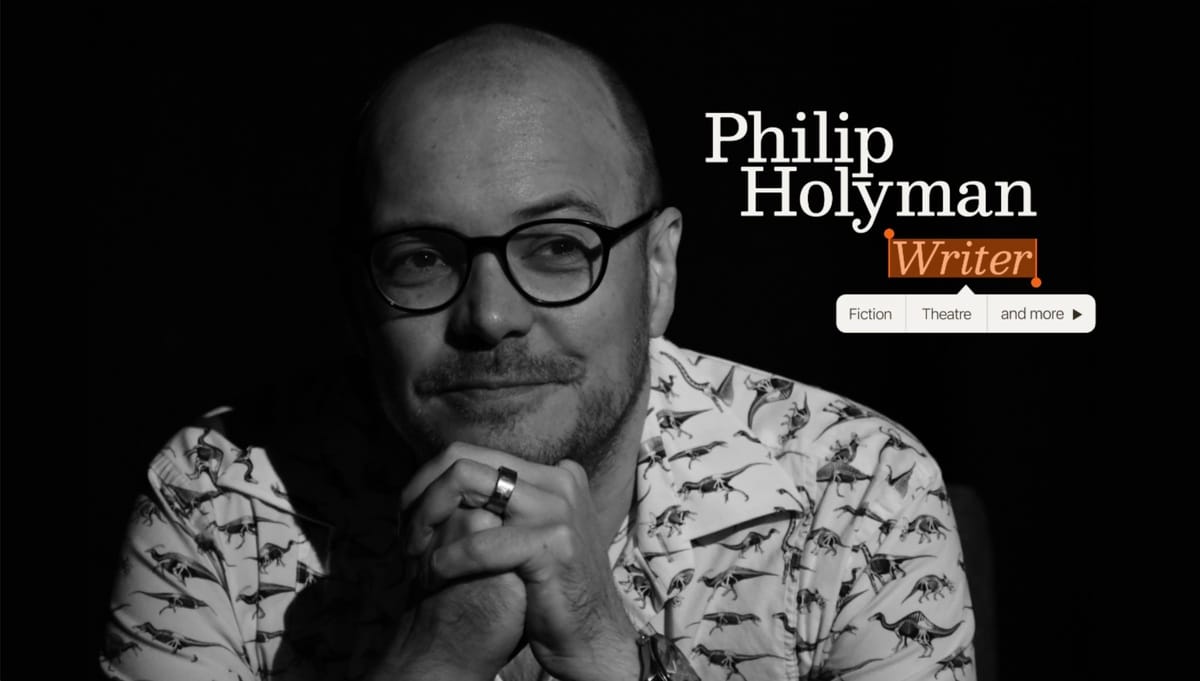
Beehiiv is where I’ll be sharing a selection of posts from “But anyway, I digress…” which is my regular blog over on my personal website — to see all my posts in full, and for more information about my writing, head over to philipholyman.com

9th December 2025
Maybe it’s the dark side of that old December feeling, with Christmas on the way (and all its pressures and expectations), and with New Year’s Eve (one of my very, very least favourite days of the year) lurking on the horizon.
Whatever it is, at the risk of not sounding very festive, I’ve found myself thinking a lot about my own mortality this month.
I don’t think I spend every December wondering how long I’ve got left or what I’m doing with the time that remains, though. The playwright Tom Stoppard died recently, and as you’ll see in a while, that fact might have played a part in my morbid thoughts.
I can’t honestly say I’ve seen many of Stoppard’s plays on stage and I can’t honestly say that those I saw did very much for me. There’s something very specific and individual about his style, deeply intellectual, often quite highbrow, even a bit arch; characters have a habit of stating mathematical or historical anecdotes instead of talking to each other like real people. It’s been easy for Stoppard shows to leave me feeling quite stupid in the past, and that’s not something I enjoy paying good money to go to a theatre to experience.
The thing I will always love about Stoppard, though, is his spectral hand in the script for Indiana Jones and the Last Crusade.
Stoppard was tasked with giving the film “a bit more heart”, dialing up the emotion but without it tipping over into sentiment. (I wouldn’t immediately think of him as an emotional writer, let alone a sentimental one, but something — perhaps a reported $2 million paycheque — seems to have unlocked the magic here.) The sparky, spiky relationship between Indiana Jones and his father Henry is one of the main aspects of the script to benefit from Stoppard’s touch. Steven Spielberg has often said that Stoppard was “pretty much responsible for every line of dialogue.”
There’s also a brilliant, bonkers bit that’s all Stoppard’s doing, where Jones Snr uses his umbrella to frighten a flock of seagulls into taking flight, so that they crash into the Nazi fighter plane pursuing him and Indy. “I suddenly remembered my Charlemagne,” Jones Snr says. “Let my armies be the rocks and the trees and the birds in the sky.” It’s bollocks, of course, and I mean that in the most admiring way. There’s no such quote from Charlemagne. But what a magnificently authentic-sounding line to give to Sean Connery’s silver fox medievalist at a moment like that! Genius. But anyway, I digress.
Stoppard was 88 when he died, and there’s something mysterious and significant for me about that, because I’m aware of quite a number of writers who also died at exactly that age. (No doubt, if I did research into the writers who have other ages in common when they die, I’d find plenty of similarities and portentous connections there, as well.)
My beloved Ursula K. Le Guin, who needs no introduction from me, was 88 when she died in 2018. The list goes on. Earlier this year was Jilly Cooper, an apparent favourite of our late Queen and close friend of our present Queen, who was the author of copious bonkbuster novels such as Riders. And going further back, there’s Edward Albee, the American playwright most remembered for Who’s Afraid of Virginia Woolf; Raymond Briggs, he of The Snowman fame; the Nobel Prize winner Toni Morrison, who is perhaps best known for Beloved.
Slightly less familiar names include Jean Rhys, who died in 1979 twelve days after I was born, and who I only really know for Wide Sargasso Sea, her Jamaica-set prequel to Charlotte Brontë’s Jane Eyre; Wilbur Smith, the South African novelist specialising in adventure stories and historical fiction; Tom Wolfe, the man in the white suit, who I always forget wrote The Right Stuff, about the first American astronauts; Kenzaburo Oe, also a Nobel Prize winner, celebrated chronicler of the complexities of post-WW2 Japan; William Trevor, the Irish novelist who was a five-time Booker nominee... And there’ll be plenty more, I’m sure.
[UPDATE: 12th June 2026 — David Hockney, the round-spectacled chronicler of swimming pools and much more besides, has also died at the age of 88.]
I’ve often heard talk of the 27 Club, made up of musicians like Kurt Cobain, Janis Joplin, Jimi Hendrix, Amy Winehouse and Jim Morrison, who all died at that shockingly young age. I’ve never heard of an equivalent 88 Club for writers, but I’m tempted now to wonder if one should unofficially exist.
At the time of writing this post, I’m 46; halfway to 47, really. How would I feel about living and writing to the age of 88? How do I feel, imagining I might have 41 years left, and imagining what works I might complete during that time? I’d like to keep going beyond 88 as long as my mind and body are up to it. But in the big scheme of things, 88 sounds like a grand age to reach.
I’ve already decided — and this might be a bit too morbid, but I’ll share it anyway — that I want to have a crack at writing a new version of Euripides’s Alcestis when I’m close to the end, just as Ted Hughes did while he was dying from cancer (when he was 68, not 88, just in case you were wondering.) Or maybe I’ll get impatient and have a bash at writing it much earlier, then revisit the manuscript during my twilight years when I can bring a different kind of insight to it. Who knows?
I’m writing this while pink and purple clouds scud past the window, blown along in the winds at the tail end of Storm Bram. I had a Christmas Dinner pizza for lunch (topped with roast turkey, pigs in blankets, stuffing, Stilton, mozzarella and deep-fried sage) and I’ve got the leftovers in a box to reheat in the air fryer later. Our tiny flat currently resembles Santa’s grotto with two trees, battery-powered candles and long strings of coloured lights. And Gareth will be home soon.
So, all things considered, I’m in no rush to get to the age of 88. I’ve got far too much living — and writing — to do in the meantime.