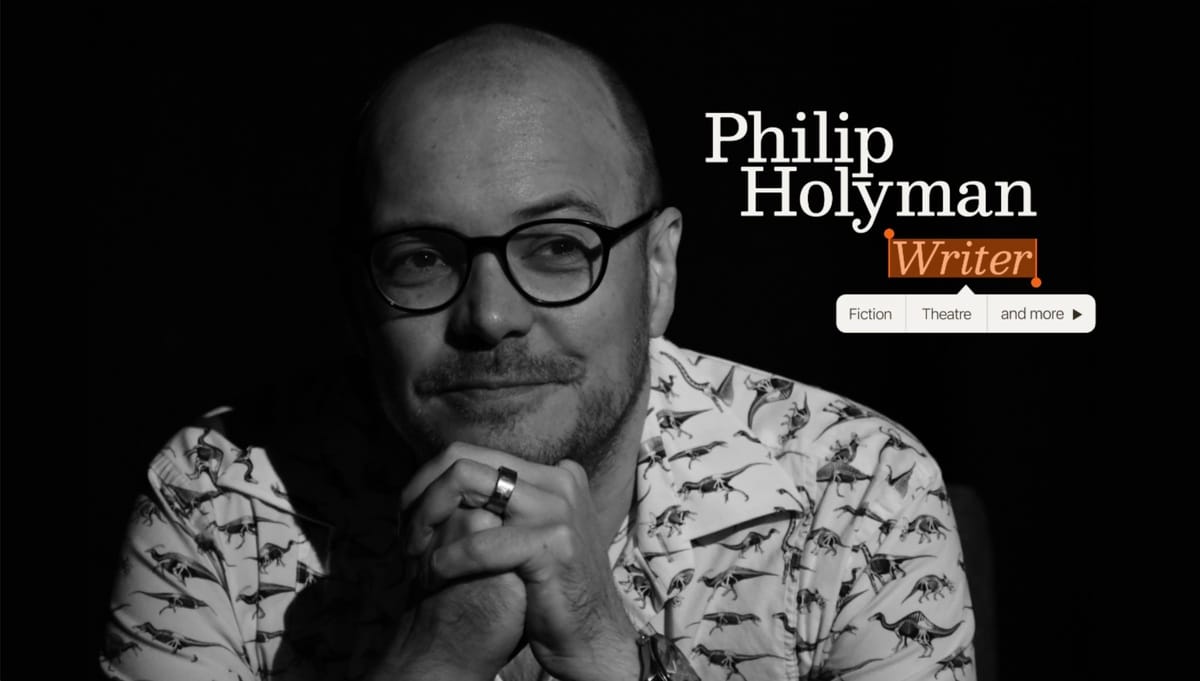
Beehiiv is where I’ll be sharing a selection of posts from “But anyway, I digress…” which is my regular blog over on my personal website — to see all my posts in full, and for more information about my writing, head over to philipholyman.com

11th November 2025
I’ve always thought of and described myself as someone who finds it difficult to make new friends or even to interact with new people. I honestly believe that to be true, but just occasionally, circumstances prove me wrong. Maybe it’s more accurate to say that sometimes I prove myself wrong.
I was in London recently for a work trip where the work got cancelled, but I was committed to trains and hotels and theatre tickets so I still went anyway, for a spontaneous solo city break. My treat after delivering a long day of training was meant to be a visit to Pick and Cheese, a conveyor belt where little plates circulate under glass cloches, each covering a wedge of fancy cheese paired with something that complements it perfectly.
Sometimes it’s an obvious pairing, like posh pickled onions or a smear of chutney. Sometimes it’s a more curious combination — chocolate brownie with Stilton, Gouda with fudge, goat’s cheese with Turkish delight. (The sweet ones demand a bit of courage to overcome the conceptual strangeness, but are always well worth a try. Stilton and brownie — big fan. Anything with Turkish delight — not so much.)
I’d paid my deposit so I went along anyway, despite not really having earned a treat. And before I knew it, I was in full conversation with the two lovely people sat at the conveyor beside me — Donna and Aaron, a mother and son down from Inverness for a few days in the big smoke. They were beyond lovely. I had an amazing hour in their company, and we talked about all sorts, from the psychotherapeutic role of the tattoo artist (Aaron’s job) to fragments of one of Morrissey’s shirts and Donna’s appearance on The One Show.
After I nervously outed myself as a writer, Donna told me how much she adores reading; Aaron told me how much he does not. Donna had a bag covered in reproduction Charles Dickens book spines which one of the restaurant servers was obsessed with. Donna confessed that she had given Virginia Woolf a try, but discovered she didn’t get on at all with her style.
She was also emphatic about some other things she doesn’t like reading. Romance was one. And the other was “shenanigans”, as she beautifully put it. Or, as Aaron beautifully put it, “tomfoolery”.
“Oh, there’s plenty of that in the book I’ve just written…” I said, leafing through the manuscript in my head. Particularly, the bits which feature the ultra-long-distance orgasm generator (ULDOG, for short), and the episode where my two heroes put it to ultra-long-distance use for its precise designated purpose.
Donna and Aaron were both adamant that I will end up getting published one day — apparently, between us, we’ve now manifested this destiny over communal plates of cheese, which I’m thrilled about. And so, to ensure Donna can read Obsolete Constellations with perfect peace of mind, a promise was made: when the book goes to press, I will ensure that the sex scenes are printed in green ink. (My future publisher is just going to LOVE me telling them that.)
When Donna gets to a section in green, she’ll know to skip past it to the other side of the shenanigans. Problem solved.
The more I think about it, the more of a wonderful idea I think it is. I asked the internet if there’s a precedent for such a typographic device. The po-faced AI summary made me smile so much, I had to reproduce it here verbatim:
“There is no standard or common practice for using different colored ink for sex scenes in printed books. The decision of how to present such content is a matter of authorial style and publisher choice, and most books use standard black ink throughout, regardless of the scene’s content.
Standard Practice: The vast majority of novels, including those with explicit scenes, use standard black ink. This keeps production costs down and follows the established norms of the publishing industry.
Authorial Choice: The presentation of sexual content is determined by the author and their publisher, and it’s a creative decision rather than a technical one.
Reader Experience: Different colored ink is not used to signal sex scenes to the reader in printed books. The narrative tone and descriptive language are the primary tools for conveying the nature of the scene.”
I can assure you that I use both narrative tone and VERY descriptive language to convey the nature of my tomfoolery episodes. Last October, when I was in the thick of writing the first draft of OC, I posted about the delightful challenges of writing sex scenes, especially when it comes to point-of-view and vocabulary. It never occurred to me at the time that I could use colour as well.
The applications for this polychromatic process are endless. Now that trigger warnings are so prevalent in relation to highlighting the content of cultural artefacts, a shift of colour on a printed page could be a really simple way to help readers make choices about what they read and what they avoid.
An increasing number of conservatives and religious types are on a mission to get books banned which do not represent the world as they would like to see it, and it’s tempting to think that a coloured ink countermeasure might forestall some of their censorious impulses — but of course, such people don’t want to enable us to exercise choice about what we read; they want to be able to exercise such choices for us. It surely won’t be long before they skip banning and go straight to burning again.
In the meantime, and in spite of the gathering forces, I’ll keep writing paragraphs of smut (only when I feel a story thoroughly justifies it, of course) — and one day, if — no, when — my work makes it into print, let’s hope I find a publisher willing to help me make good on my cheese conveyor promise, and that the shenanigans gleam up at you from the page in a torrid stream of glorious green.