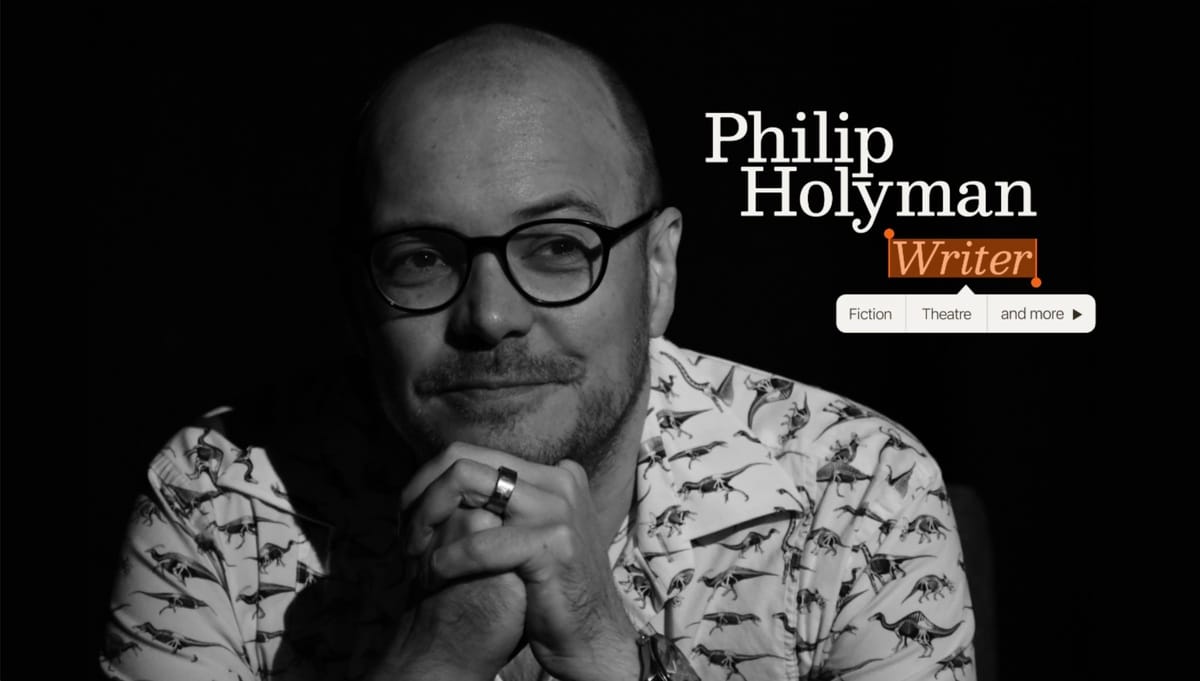
Beehiiv is where I’ll be sharing a selection of posts from “But anyway, I digress…” which is my regular blog over on my personal website — to see all my posts in full, and for more information about my writing, head over to philipholyman.com

25th November 2025
Back in 2024, when I was at Birchfield Library doing my site visit that led to my piece for Brum Library Zine, I took a photo of a book from the science fiction shelves that I promised myself I must read one day: Of Ants & Dinosaurs by Liú Cíxīn (he of The Three-Body Problem fame) in a translation by Elizabeth Hanlon.
The back cover describes it as “a satirical fable, a political allegory and an ecological warning”. It imagines an alternative past where ants and dinosaurs embark on a global period of collaboration which results in the spectacular rise and spectacular fall of their respective civilisations. It’s quite a short book, but I have to confess I found it a bit of a struggle.
I can’t tell if I didn’t warm more to Liú’s style of writing or Hanlon’s style of translating — my feeling is that it was a bit of both. I absolutely can’t forgive Liú for including Stegosaurus (which died out by the end of the Jurassic) in his late Cretaceous-set story, or for his lack of regard when it comes to identifying most of the dinosaur species at all, above and beyond a seeming fixation on Tyrannosaurus and its Asian cousin Tarbosaurus. (Any reasonably dino-minded six-year-old would find fault with this, I reckon.)
The narrative style itself felt quite awkward, even basic for the most part. It would be easy to say this is a fault of allegory as a literary form — but read a single chapter of George Orwell’s Animal Farm and you’ll see how writing that’s economical doesn’t have be rudimentary in expression at the same time. Whatever issues I might have with Liú’s turns of phrase, they’re certainly not helped by some of Hanlon’s many unfortunate flourishes. I’ll pick out one example:
“Being wise to the possible consequences, they hurriedly scurried beneath the sturdy crystal platter to avoid being flattened beneath the dinosaurs’ feet.”
Reading the words “hurriedly scurried” had me tutting out loud on a busy train at the sight of such a painful bit of unnecessary rhyming. (The construction is even more painful if you read the sentence out loud, which I can only assume neither Hanlon herself nor any subsequent editors ever saw fit to do, else it would surely have been replaced immediately.) But anyway, I digress.
Much is made throughout the book of the fundamental difference between the ants’ and the dinosaurs’ ways of thinking. The section reproduced below captures it very well, despite my aversion to the phrase “flicked her antennae forcefully” that gets used (Hanlon’s translatorial choice, presumably) when the first ant speaks:
“No, no…” Professor Joya flicked her antennae forcefully. “Supreme Consul Kachika, you have confused technology with science. It’s true that ants make outstanding engineers, but we will never be scientists. The physiology of our brains is such that we will never possess those two dinosaur traits: curiosity and imagination.”
Senator Birubi shook her head in disagreement. “Curiosity and imagination? What nonsense, Professor. You surely can’t believe those are enviable traits? That’s precisely what makes the dinosaurs such neurotic, moody, unpredictable creatures. They fritter away their time lost in fantasies and daydreams.”
“But, Senator, that unpredictability and those fantasies are what lie behind their creativity.”
The bold highlights are my emphasis. Ant minds are variously described as “calculating”, “simplistic”, “mechanical” (despite the ants’ top brass repeatedly insisting this is not the case), and only dinosaurs are considered capable of being visionary or theoretical. At the same time, the dinosaurs can be reckless and irresponsible and illogical, led by impulse and emotion and often showing little regard for the future consequences of their actions. The ants, by contrast, have great strategic capacity and are forensically thorough, even if they sometimes miss an implication that is staring them right in the face.
Liú, to his credit, never establishes one way as being better than the other; the advantages and disdvantages of each are made manifest, and cumulatively lead to the explosive, Dr. Strangelove-like conclusion. (Representatives of one of the two kinds of organism do survive the apocalypse, though, and you can easily guess which side they will belong to…)
I really like the proposition that creativity comes with such obvious costs, such unhelpful personality quirks. Simply put, pretty much every single one of the main dinosaur protagonists behaves like a massive dick. Is dickishness, I wonder, a price worth paying for access to the joys and freedoms of curiosity and imagination?
When it comes down to it, what would you rather be — more ant, or more dinosaur?